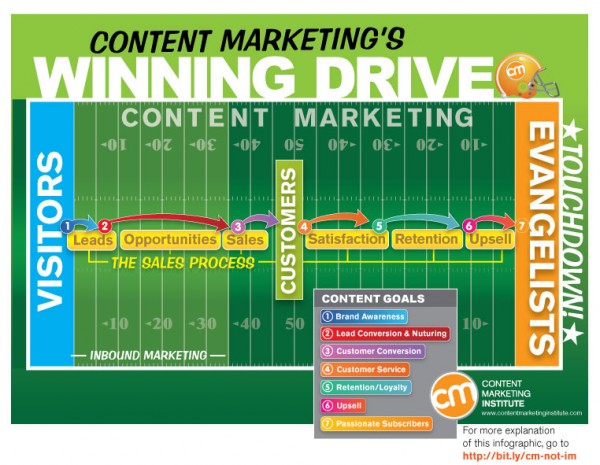
It needs a strategic approach and that’s what a content marketing strategy is all about. Content marketing fits in a broader integrated marketing strategy and it requires a strategy of its own. However, just as all other strategies regarding specific marketing techniques (email marketing or social media marketing, for instance) such a strategy needs to be integrated in a broader strategy.
A content marketing strategy (not to be confused with a content strategy) analyzes the different ways content marketing can be used across the buyer’s journey, the customer life cycle and/or the different customer experience touchpoints but it goes beyond that. Essentially a content marketing strategy looks how content marketing (not content) can be used in a strategic way as such and for and with other marketing, customer and sales strategies.
Questions to address in a content marketing strategy
Who are the buyer personas and what are their content needs and preferences? This questions looks at the type of information different ‘archetypes’ of buyers seek during their buying journey and maps the customer touchpoints, preferred communication channels, and – to some extent – the content formats, although that’s a question for the content strategy too. Buyer personas haven’t been invented for content marketing. They are used for an overall marketing strategy. But in a content marketing strategy you take a more complete look at them.
Which marketing and other organizational goals can we realize or improve by better using content marketing? An example: traffic building, conversion optimization, event marketing, lead generation and management, email marketing, social media marketing, marketing automation, customer service, etc. can all be improved by a better usage of content and content marketing. Your content marketing strategy looks at this. As a matter of fact, don’t just ask what organizational goals content marketing serves as in the chart. Many people, especially those calling the buying shots, have no clue what content marketing is and so do many executives, even in marketing. So, ask what organizational goals you can support and strengthen instead of trying to separate content marketing from the overall equation.
Which content marketing metrics and KPIs do we need to gauge success, in correlation with other marketing metrics and KPIs? Although there are some typical metrics used in content marketing it’s important to speak a common language across all marketing and even business efforts. Content marketing is not an island. One of the crucial success factors in implementing marketing ROI across the organization and content marketing ROI as well is finding common metrics and using a common language between different departments.
How will we structure the internal organization – or better: how will we make sure that all content marketing related processes and flows are properly organized, in correlation with other marketing processes and/or teams? Often, content marketing thinkers advice to build teams that are more or less dedicated to content marketing. In practice, this seldom happens (except in some major firms) and teams better focus on the tasks and goals than the exact roles, realizing each company is different.
For which other marketing goals and even business purposes – on top of the usual suspects – can we use content marketing? Examples: to support your customer service team, to empower sales, to optimize website conversions, etc.
Which organizational processes, stumbling blocks, competitor data, management goals, customer insights, business stakeholders, teams, external partners, overall marketing priorities, etc. do I need to know in order to succeed? Before even thinking about content strategy, content inventorization or content production, these crucial questions need to be known.
How is the industry you are in changing? And more specifically: how is the buyer’s journey of your buyer personas evolving in the industries your customers are active in and your business is active in. What role can content marketing play? As an example: look at the evolutions in the B2B services industry. Content plays a clear role but look further. For instance: Key Account Management is a priority in that industry. Can it be served using an optimized content marketing strategy? Also look at the influencer sphere of the buyers in that industry and at the different types of buyers.
What questions do we need to answer and steps do we need to plan to put our content marketing strategy in action and move to the content strategy that looks at more content-related aspects?
What existing budgets can we tap into to better achieve the goals using content in areas where return is below expectations (and what are these areas, of course)? An example: you may have an overall budget for your website but maybe it’s better to invest in more relevant content for your buyer personas instead and putting that design makeover on hold this year. Or maybe your organization invests a bit too much in generating traffic and leads but conversions stay behind. You can turn down the volume a bit and invest more in conversion optimization and lead nurturing, using content.
How do we forecast and get budgets when no existing budgets can be tapped into or adapted? If your organization is missing out on important opportunities – and it always is – you need to make the calculated case for additional budgets.
Why Content Marketing?
After asking "What is content marketing?" the next question should be "why?"
"First you need to understand the four steps of the typical buying cycle:
Awareness.
Research.
Consideration.
Buy.
Traditional advertising and marketing is great when it comes to the second two steps, but after that it tends to trail off. Content marketing taps into the first two stages of the buying process by raising awareness of solutions and educating consumers about a product they may have never considered before....
The return on investment for content marketing can be phenomenal....It provides additional content for social media marketing and contributes to SEO efforts by generating natural inbound links and building up good content on your website that gets found in search engines.
In fact, for many companies the bulk of their SEO efforts should be focused on content marketing."
Content marketing is about information.
In other words, it's the marketing of a business or brand through the sharing of educational, entertaining, or insightful information that will ultimately help readers improve their lives.
This may be in the form of a change in personal behavior or, as most marketers hope, it could be in the form of a purchase decision.
It's not about forcing a sales pitch at people, but helping them move towards the best course of action (that just may be buying from you).
Content marketing is also defined as a strategic marketing approach focused on creating and distributing valuable, relevant, and consistent content to attract and retain a clearly-defined audience — and, ultimately, to drive profitable customer action."
I'd say that accurately sums it up, but perhaps a more accurate description is provided by Content Marketing Institute:
"Content marketing’s purpose is to attract and retain customers by consistently creating and curating relevant and valuable content with the intention of changing or enhancing consumer behavior. It is an ongoing process that is best integrated into your overall marketing strategy, and it focuses on owning media, not renting it."
In 2016, few businesses doubt the power of content marketing, but sadly, only a few companies are executing it with the skill and expertise truly needed to make an impact.
This guide will show you how to successfully promote your brand, attract more qualified leads, and nurture customer relationships through content marketing.
If you've read any of our content, you've probably heard us throw around the term "inbound marketing." Content and inbound are often used interchangeably, but for the sake of minimizing confusion I will explain the difference.
Want to use LinkedIn’s vibrant community to boost qualified traffic, generate leads, and meet your target personas? Find out how in our free guide.
The difference between inbound marketing and content marketing depends on who you ask. In fact, a HubSpot survey found that most marketers agree that content marketing is a subset of inbound marketing.
Content marketingis a form of marketing focused on creating, publishing, and distributing content for a targeted audience online.[1] It is often used by businesses in order to:
Attract attention and generate leads
Expand their customer base
Generate or increase online sales
Increase brand awareness or credibility
Engage an online community of users
Content marketing attracts prospects and transforms prospects into customers by creating and sharing valuable free content. Content marketing helps companies create sustainable brand loyalty, provides valuable information to consumers, and creates a willingness to purchase products from the company in the future. This relatively new form of marketing does not involve direct sales. Instead, it builds trust and rapport with the audience.[2]
Unlike other forms of online marketing, content marketing relies on anticipating and meeting an existing customer need for information, as opposed to creating demand for a new need. As James O'Brien of Contently wrote on Mashable, "The idea central to content marketing is that a brand must give something valuable to get something valuable in return. Instead of the commercial, be the show. Instead of the banner ad, be the feature story."[3] Content marketing requires continuous delivery of large amounts of content, preferably within a content marketing strategy.[4]
When businesses pursue content marketing, the main focus should be the needs of the prospect or customer. Once a business has identified the customer's need, information can be presented in a variety of formats, including news, video, white papers, e-books, infographics, email newsletters, case studies, podcasts, how-to guides, question and answer articles, photos, blogs, etc.[5][6] Most of these formats belong to the digital channel.
Digital content marketing is a management process that uses electronic channels to identify, forecast, and satisfy the content requirements of a particular audience. It must be consistently updated and added to in order to influence the behavior of customers.
Content marketing is used by leading brands
Our annual research shows the vast majority of marketers are using content marketing. In fact, it is used by many prominent organizations in the world, including P&G, Microsoft, Cisco Systems, and John Deere. It’s also developed and executed by small businesses and one-person shops around the globe. Why? Because it works.
Here is just one example of content marketing in action:
Content marketing is good for your bottom line — and your customers
Specifically, there are three key reasons — and benefits — for enterprises that use content marketing:
Increased sales
Cost savings
Better customers who have more loyalty
Content is the present – and future – of marketing
Go back and read the content marketing definition one more time, but this time remove the relevant and valuable. That’s the difference between content marketing and the other informational garbage you get from companies trying to sell you “stuff.” Companies send us information all the time – it’s just that most of the time it’s not very relevant or valuable (can you say spam?). That’s what makes content marketing so intriguing in today’s environment of thousands of marketing messages per person per day.
Marketing is impossible without great content
Regardless of what type of marketing tactics you use, content marketing should be part of your process, not something separate. Quality content is part of all forms of marketing:
Social media marketing: Content marketing strategy comes before your social media strategy.
SEO: Search engines reward businesses that publish quality, consistent content.
PR: Successful PR strategies address issues readers care about, not their business.
PPC: For PPC to work, you need great content behind it.
Inbound marketing: Content is key to driving inbound traffic and leads.
Content strategy: Content strategy is part of most content marketing strategies.
To be effective at content marketing, it is essential to have a documented content marketing strategy. Download our 16-page guide to learn what questions to ask and how to develop your strategy.
What if your customers looked forward to receiving your marketing? What if when they received it, via print, email, website, they spent 15, 30, 45 minutes with it? What if they anticipated it and shared it with their peers?
If you are intrigued and ready to learn more, we can help. Here are a few popular ways to dig in:
New to content marketing? Check out our getting started guide, where you’ll learn the definition of content marketing, as well as basic steps for putting a content marketing plan in place.
Need a content strategy? Read the CMI Content Marketing Framework, which outlines the essential building blocks for a successful content marketing program.
Looking for some content marketing examples? Download our Ultimate e-book: 75 Content Marketing Examples.
Are you in marketing leadership? Subscribe to our free magazine, Chief Content Officer, to stay on top of the latest industry trends.
Need advice specific to your organization? Contact our consulting group, led by strategist Robert Rose, to find out how they can help you meet your content marketing challenges.
If at any time you have questions about content marketing, don’t hesitate to reach out and ask us.
What Is Content Marketing?
Useful content should be at the core of your marketing
Content marketing is a strategic marketing approach focused on creating and distributing valuable, relevant, and consistent content to attract and retain a clearly defined audience — and, ultimately, to drive profitable customer action.
Instead of pitching your products or services, you are providing truly relevant and useful content to your prospects and customers to help them solve their issues.
 It needs a strategic approach and that’s what a content marketing strategy is all about. Content marketing fits in a broader integrated marketing strategy and it requires a strategy of its own. However, just as all other strategies regarding specific marketing techniques (email marketing or social media marketing, for instance) such a strategy needs to be integrated in a broader strategy.
Table of Contents [hide]
A content marketing strategy (not to be confused with a content strategy) analyzes the different ways content marketing can be used across the buyer’s journey, the customer life cycle and/or the different customer experience touchpoints but it goes beyond that. Essentially a content marketing strategy looks how content marketing (not content) can be used in a strategic way as such and for and with other marketing, customer and sales strategies.
It needs a strategic approach and that’s what a content marketing strategy is all about. Content marketing fits in a broader integrated marketing strategy and it requires a strategy of its own. However, just as all other strategies regarding specific marketing techniques (email marketing or social media marketing, for instance) such a strategy needs to be integrated in a broader strategy.
Table of Contents [hide]
A content marketing strategy (not to be confused with a content strategy) analyzes the different ways content marketing can be used across the buyer’s journey, the customer life cycle and/or the different customer experience touchpoints but it goes beyond that. Essentially a content marketing strategy looks how content marketing (not content) can be used in a strategic way as such and for and with other marketing, customer and sales strategies.


 "First you need to understand the four steps of the typical buying cycle: